- 👥 Players
- 2–10
- 🎂 Ages
- 7+
- ⏱ Playing time
- 15–45 min
- ⭐ Difficulty
- Easy
- 🎲 You need
- One UNO deck (108 cards, or 112 in decks made since 2018), paper and pen if you keep score
- Deal 7 cards to each player and turn over the top card of the deck to start the discard pile.
- On your turn, play a card that matches the top card by colour, number or symbol, or play a Wild card.
- If you can't (or don't want to) play, draw one card. You may play that card straight away if it fits.
- Action cards change the game: Skip, Reverse, Draw Two, Wild and Wild Draw Four.
- Say "UNO" when you have one card left. The first player to get rid of all their cards wins the round.
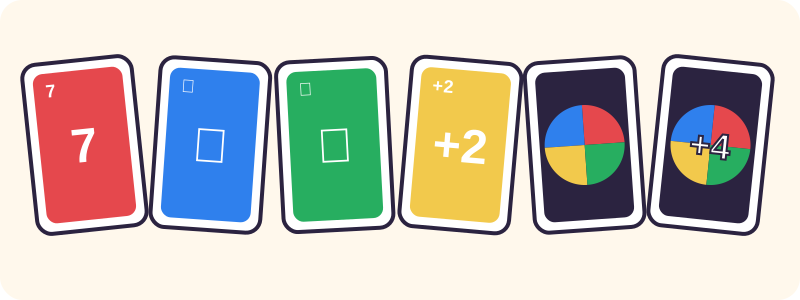
UNO is the card game that turns calm family evenings into loud ones. It was created in 1971 by Merle Robbins, a barber in Ohio, and today it is published by Mattel. If you have ever played Crazy Eights or Mau-Mau, you already know the basic idea: match the top card by colour or number and be the first to empty your hand. UNO adds a set of action cards that make every round unpredictable.
Below are the official rules first. House rules, like stacking +2 cards, have their own section further down so you can decide which ones your table uses.
The goal of UNO
Be the first player to get rid of all the cards in your hand. In the points version, you also collect points for the cards left in your opponents' hands, and the first player to reach 500 points wins the game.
What's in the deck
A classic UNO deck has 108 cards in four colours (red, yellow, green and blue) plus black Wild cards:
| Card | In each colour | Total | Points |
|---|---|---|---|
| 0 | 1 | 4 | 0 |
| 1 to 9 | 2 of each | 72 | Face value |
| Skip | 2 | 8 | 20 |
| Reverse | 2 | 8 | 20 |
| Draw Two | 2 | 8 | 20 |
| Wild | – | 4 | 50 |
| Wild Draw Four | – | 4 | 50 |
Decks printed since 2018 have 112 cards. They add one Wild Shuffle Hands card and three customisable Wild cards that you can write your own rule on. You can leave them out and play the classic game.
How to set up
- Each player draws a card; the highest number deals (action cards count as zero).
- Shuffle and deal 7 cards to each player, face down.
- Place the rest of the deck face down in the middle. This is the draw pile.
- Turn over the top card of the draw pile to start the discard pile.
If the first card is an action card: under the current rules (2022), you simply put it back and turn over another card until a number card appears. Older instruction sheets apply the card instead: a Skip means the player to the dealer's left misses their turn, a Reverse means the dealer plays first and play goes to the right, a Draw Two makes the first player draw two and miss their turn, a Wild lets the first player choose the colour, and a Wild Draw Four goes back into the deck. Both versions are fine; just agree before you start.
The player to the dealer's left goes first, and play continues clockwise.
How a turn works
On your turn, look at the top card of the discard pile. You may play one card from your hand on top of it if it matches by:
- colour (a red 3 on a red 8),
- number (a blue 7 on a green 7), or
- symbol (a yellow Skip on a red Skip).
You can also play a Wild card at any time, and a Wild Draw Four under the condition explained below.
If you have no card you can play, draw one card from the draw pile. If that card can be played, you may put it down right away. If not, your turn is over. You cannot play a different card from your hand after drawing.
Under the official rules you may also choose to draw instead of playing a card you could have played.
When the draw pile runs out, keep the top card of the discard pile, shuffle the rest and turn it face down as the new draw pile.
The action cards
Skip
The next player loses their turn. Play passes to the player after them.
Reverse
Play changes direction: clockwise becomes anticlockwise, and the other way round. With two players, Reverse works like a Skip and you play again.
Draw Two (+2)
The next player draws two cards and loses their turn. You can only play it on a card of the same colour or on another Draw Two.
Wild
Play it on any card and choose the colour that play continues in. You may choose the colour that is already in play.
Wild Draw Four (+4)
You choose the next colour, and the next player draws four cards and loses their turn. There is one important restriction: you may only play it if you have no card that matches the current colour. Having a card that matches the number or symbol is allowed; only the colour counts.
Challenging a Wild Draw Four
If you think the player who hit you with a +4 still had a card of the right colour, you can challenge them. They must show you their hand (only you see it):
| Result of the challenge | What happens |
|---|---|
| They had a matching colour (guilty) | They draw the 4 cards instead of you, and you play normally |
| They didn't (innocent) | You draw 6 cards (the 4 plus 2 extra) and lose your turn |
Wild Shuffle Hands (112-card decks)
Collect every player's hand, shuffle them together and deal them out again, starting with the player to your left. Then choose the colour that continues play.
Calling UNO
When you play your second-to-last card, you must say "UNO!" to warn everyone you have one card left. If another player catches you before the next player starts their turn, you draw 2 cards as a penalty. If nobody catches you in time, you're safe.
Winning a round and scoring
The round ends as soon as one player plays their last card. If that last card is a Draw Two or Wild Draw Four, the next player still draws the cards.
In the points game, the winner of the round scores the cards left in everyone else's hands:
| Cards | Points each |
|---|---|
| Number cards (0 to 9) | Face value |
| Skip, Reverse, Draw Two | 20 |
| Wild, Wild Draw Four, Wild Shuffle Hands, customisable Wild | 50 |
The first player to reach 500 points wins the game.
Alternative scoring: each player writes down the points left in their own hand at the end of each round. When someone reaches 500, the player with the lowest total wins. This version keeps everyone in the game longer.
Since the 2022 rules, keeping score is officially optional: many families simply play single rounds and the first player to go out wins.
UNO with 2 players
All rules stay the same, with two changes in practice:
- Reverse works like Skip: you play again.
- Skip and Draw Two also give you another turn right away, because there is no one else to pass to.
With two players, playing an action card as your second-to-last card can let you go out on the same turn. Don't forget to say UNO.
Popular house rules
These are not in the official rules, so agree on them before you deal:
- Stacking: if someone plays a +2 on you, you may play another +2 and pass the total to the next player. Some tables also allow +4 on +2. Mattel has said publicly that this is not an official rule.
- Draw until you can play: instead of drawing one card, keep drawing until you find a playable card.
- Seven-O: whoever plays a 7 swaps hands with another player of their choice; when a 0 is played, everyone passes their hand to the next player in the direction of play. This rule appears as an optional rule in recent official instructions.
- Jump-in: if you hold a card that is identical (same colour and number) to the card just played, you may play it immediately, out of turn. Play continues from you. Also listed as optional in recent instructions.
- No finishing on an action card: some tables say your last card must be a number card. Officially you can finish on any card.
Tips to win more often
- Save your Wild cards. A Wild is your escape card when you have no match. Use it early only if it helps you get out of trouble.
- Count colours. If the player after you keeps drawing on red, they probably have no red. Switch to red when you can.
- Play high numbers early in the points game. If someone else goes out, a 9 in your hand gives them 9 points; a 0 gives nothing.
- Hold a +2 or +4 for the end. When the next player calls UNO, an action card can stop them from going out.
- Play your +4 honestly. A failed bluff costs you four cards, and experienced players challenge often.
Common mistakes
- Playing a Wild Draw Four while holding a card of the current colour.
- Drawing several cards in one turn under the official rules (only one card).
- Playing a card from your hand after drawing (only the drawn card may be played).
- Saying "UNO" too late. You have to say it when you play your second-to-last card, before the next player starts their turn.
- Forgetting that the next player still draws when you finish on a Draw Two or Wild Draw Four.
Where UNO comes from
UNO belongs to the family of "shedding" card games such as Crazy Eights in the US, Mau-Mau in Germany and Pesten in the Netherlands, all played with a normal deck of cards. Merle Robbins created UNO in 1971, sold early copies from his barber shop, and the game was later bought by International Games and then by Mattel, which still publishes it today. UNO is a registered trademark of Mattel; Rulanza is independent and not affiliated with Mattel.
Frequently asked questions
Can you stack Draw Two or Draw Four cards in UNO?
Not under the official rules. When a Draw Two or Wild Draw Four is played on you, you draw the cards and lose your turn. Mattel confirmed in 2019 that stacking is not part of the standard rules, although it is a very common house rule.
Can you play a Wild Draw Four whenever you want?
No. You may only play it when you have no card that matches the colour of the top card on the discard pile. You may still hold matching numbers or action cards of other colours. The next player can challenge you if they think you broke this rule.
What happens if you forget to say UNO?
If another player catches you before the next player starts their turn, you draw two cards as a penalty. If nobody notices in time, there is no penalty.
Can you finish UNO on an action card?
Yes. You can go out with any card, including a Wild Draw Four. If your last card is a Draw Two or Wild Draw Four, the next player still has to draw, and those cards count towards your score.
How many cards do you draw if you can't play?
Only one. If it can be played, you may play it immediately; otherwise your turn ends. Drawing until you find a playable card is a popular house rule, not an official one.
How does UNO work with 2 players?
The rules are the same, but a Reverse works like a Skip, so you play again straight away. A Skip also lets you play again.
How many cards are in an UNO deck?
A classic deck has 108 cards: 76 number cards, 24 coloured action cards and 8 Wild cards. Decks made since 2018 have 112 cards because they add a Wild Shuffle Hands card and three customisable Wild cards.
How many points do you need to win UNO?
In the points game, the first player to reach 500 points wins. Number cards are worth their face value, Skip, Reverse and Draw Two are worth 20, and Wild and Wild Draw Four are worth 50. Recent official rules treat scoring as optional: you can simply play single rounds.
Sources
We check every rule against these references. Where sources disagree, we say so in the text.