- 👥 Players
- 4 (2–6)
- 🎂 Ages
- 10+
- ⏱ Playing time
- 60–120 min
- ⭐ Difficulty
- Advanced
- 🎲 You need
- Two standard 52-card decks plus 4 jokers (108 cards), paper and pen for the score
- Four players in two partnerships, two decks plus four jokers, 11 cards each.
- On your turn, draw one card from the stock or take the whole discard pile, meld if you can, then discard one card.
- Melds are 3 or more cards of the same rank. Jokers and 2s are wild, but each meld needs more natural cards than wild ones.
- A meld of 7 cards is a canasta and earns a big bonus. Your side needs at least one canasta to go out.
- Red threes are bonus cards, black threes block the pile. The first side to 5,000 points wins.
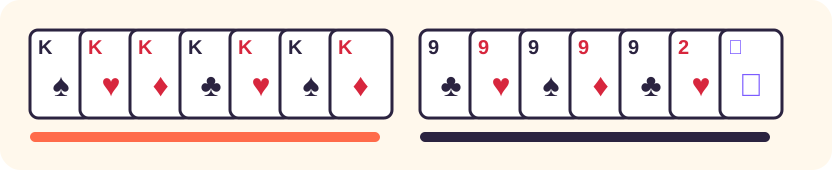
Canasta was invented in Uruguay in the late 1930s and swept across the Americas and Europe in the 1950s. It is a partnership game in the rummy family: you build groups of cards of the same rank and try to complete canastas, melds of seven cards that bring big bonuses. It takes a little longer to learn than gin rummy, but after one or two hands it all clicks.
These are the classic canasta rules for four players in two teams. Modern American canasta (with draw-two and more complex rules) and the two-player version are covered under variations.
The goal of canasta
Score more points than the other team by melding cards, completing canastas and collecting bonuses. The first side to reach 5,000 points at the end of a hand wins the game.
Partners sit opposite each other and share one set of melds on the table.
The cards and their values
You need two standard decks plus four jokers, 108 cards in total.
| Cards | Points each | Notes |
|---|---|---|
| Joker | 50 | Wild |
| 2 | 20 | Wild |
| Ace | 20 | |
| K, Q, J, 10, 9, 8 | 10 | |
| 7, 6, 5, 4 | 5 | |
| Black 3 | 5 | Stop card, see below |
| Red 3 | 100 bonus | Bonus card, never melded |
Wild cards (jokers and 2s) can stand in for any natural card from 4 to ace in a meld.
Melds and canastas
A meld is 3 or more cards of the same rank, for example three 8s, or 8-8-joker. Suits don't matter. Rules for melds:
- Every meld needs at least two natural cards.
- A meld may contain at most three wild cards.
- You can't meld wild cards on their own.
- Each team has only one meld per rank: if your partner has melded 8s, you add your 8s to that same meld.
- You may keep adding cards to your team's melds at any time on your turn.
A meld of 7 or more cards is a canasta. Square it up into a pile, with a red card on top for a natural canasta and a black card on top for a mixed one:
| Canasta | Made of | Bonus |
|---|---|---|
| Natural ("red") canasta | 7 natural cards, no wild cards | 500 |
| Mixed ("black") canasta | 7 cards including 1 to 3 wild cards | 300 |
A canasta can grow beyond seven cards. Adding a wild card to a natural canasta turns it into a mixed canasta.
Dealing
- Shuffle both decks and jokers together. Each player draws a card to decide partners and the first dealer.
- The dealer gives 11 cards to each player, one at a time, clockwise.
- The rest of the cards are placed face down as the stock.
- Turn the top card of the stock face up to start the discard pile. If it is a wild card or a red three, turn another card on top. The pile is then frozen.
Before the first turn, any player with a red three puts it face up on the table and draws a replacement from the stock.
How a turn works
Play goes clockwise, starting with the player on the dealer's left. On your turn:
- Draw: take the top card of the stock, or take the whole discard pile (only if you're allowed to, see below).
- Meld: if you want, lay down new melds or add cards to your team's melds.
- Discard: finish your turn by putting one card face up on the discard pile.
If you draw a red three, put it face up with your melds and draw again from the stock.
Your team's first meld
The first time your team puts down cards in a hand, the cards in that meld must add up to a minimum number of points. The minimum depends on your team's total score before the hand:
| Your team's score | Minimum first meld |
|---|---|
| Below 0 | 15 |
| 0 to 1,495 | 50 |
| 1,500 to 2,995 | 90 |
| 3,000 or more | 120 |
You can reach the minimum with several melds at once. Only the card values count, not bonuses for red threes or canastas. Once your team has met the minimum, both partners can meld freely for the rest of the hand.
Taking the discard pile
Taking the pile is the heart of canasta: one good grab can give you twenty cards to meld. You can never take the pile when its top card is a wild card or a black three. Otherwise:
When the pile is not frozen (your team has melded and there is no wild card in the pile), you may take it if you can:
- meld the top card with two natural cards of the same rank from your hand, or
- meld it with one natural card and one wild card from your hand, or
- add the top card to one of your team's existing melds.
When the pile is frozen, you may take it only by melding the top card with two natural cards of the same rank from your hand.
The pile is frozen:
- for your team, until your team has made its first meld;
- for everyone, as soon as a wild card or a red three is in it. (A discarded wild card is placed sideways so everyone can see the pile is frozen.)
To take the pile, show the matching cards, meld them with the top card first (this meld counts towards your minimum if it's your first meld), then take the rest of the pile into your hand. You can then meld more and discard as normal.
Red threes and black threes
Red threes are pure bonus cards. Lay each one face up as soon as you receive it and draw a replacement. At the end of the hand each red three is worth 100 points, and all four held by one team are worth 800. But if your team hasn't melded anything by the end of the hand, the red threes count minus that amount.
Black threes are stop cards. When you discard one, the next player can't take the pile. You may only meld black threes in the turn you go out, as a group of three or four with no wild cards.
Going out
You end the hand by going out: getting rid of all your cards by melding them, usually with a final discard. Rules:
- Your team must have at least one canasta (completed now or earlier).
- Before going out, you may ask your partner "May I go out?". They must answer yes or no, and you must follow the answer.
- Going out is worth a 100-point bonus.
- If you go out concealed, melding your entire hand in one turn, including a complete canasta, without having melded anything before in that hand, the bonus is 200 instead of 100.
If the stock runs out, play continues only as long as each player takes the previous discard and melds it. When a player must draw from an empty stock, the hand ends.
Scoring a hand
At the end of each hand, each team adds up:
| Item | Points |
|---|---|
| Each natural canasta | 500 |
| Each mixed canasta | 300 |
| Each red three (team has melded) | 100 (all four: 800) |
| Going out | 100 (concealed: 200) |
| Value of all cards in the team's melds | Add |
| Value of cards still in the players' hands | Subtract |
| Red threes if the team has not melded | Subtract 100 each (all four: 800) |
Add the result to the team's running total. The game ends when a team reaches 5,000 points at the end of a hand; the higher score wins.
Canasta for 2, 3 or 6 players
- Two players: each gets 15 cards, and on each turn you draw two cards from the stock (but discard only one). You need two canastas to go out.
- Three players: everyone plays alone with 13 cards each.
- Six players: two teams of three, sitting alternately, with three decks plus six jokers and 13 cards each.
Variations
- Modern American canasta: you draw two cards per turn, the pile is always frozen, you need two canastas to go out, sevens and wild-card canastas get special bonuses, and the minimum melds are higher. Agree on which rules you use before you start.
- Hand and foot: a popular American relative where each player has two hands of cards (the "hand" and the "foot").
- Brazilian buraco and tranca are close cousins of canasta played with two decks and different scoring.
Strategy tips
- Watch the pile size. A big pile can win the hand. Freeze it with a wild card when your opponents look ready to take it.
- Don't meld too early. Keeping pairs in your hand gives you a chance to take the pile. Meld only what you need to meet the minimum.
- Hold your black threes. They're the safest discard when the pile is big.
- Use wild cards wisely. Putting wild cards on a meld turns a potential 500-point natural canasta into a 300-point mixed one.
- Talk with your discards. What you throw away tells your partner which ranks you don't need.
- Don't get stuck with cards. Cards left in your hand when the other side goes out count against you, especially jokers and aces.
Common mistakes
- Making a first meld below the minimum.
- Taking a pile topped by a black three or a wild card.
- Putting more than three wild cards in one meld.
- Going out without a canasta.
- Forgetting to subtract the cards left in your hands at the end of the hand.
Frequently asked questions
How many cards do you deal in canasta?
With four players, each player gets 11 cards. With two players, each gets 15 cards and draws two cards per turn; with three players, each gets 13.
What are the wild cards in canasta?
The four jokers and all eight 2s are wild. They can stand in for any natural card in a meld, but a meld must always have at least two natural cards and no more than three wild cards.
How many points do you need for the first meld in canasta?
It depends on your side's total score: 15 points if your score is negative, 50 from 0 to 1,495, 90 from 1,500 to 2,995 and 120 from 3,000 upwards. Only the values of the cards count, not bonuses.
When is the canasta discard pile frozen?
The pile is frozen for your side until you have made your first meld. It is also frozen for everyone when it contains a wild card or a red three. To take a frozen pile you need two natural cards in your hand that match the top card.
What do red threes do in canasta?
Red threes are bonus cards. Put each one face up in front of you as soon as you get it and draw a replacement. Each is worth 100 points (all four together 800), but they count against you if your side hasn't melded by the end of the hand.
What do black threes do in canasta?
Discarding a black three stops the next player from taking the discard pile. Black threes can only be melded when you go out, as a group of three or four with no wild cards.
How do you go out in canasta?
Your side must have at least one canasta. Then you go out by melding or discarding your last card. You can ask your partner "May I go out?" first, and their answer is binding.
How many points to win canasta?
The game is played to 5,000 points. When one or both sides reach 5,000 at the end of a hand, the side with the higher score wins.
Sources
We check every rule against these references. Where sources disagree, we say so in the text.