- 👥 Players
- 2
- 🎂 Ages
- 8+
- ⏱ Playing time
- 30–60 min
- ⭐ Difficulty
- Medium
- 🎲 You need
- One standard 52-card deck (no jokers), paper and pen for the score
- Two players, a 52-card deck. Each player gets 10 cards.
- On each turn, draw one card (from the stock or the top of the discard pile), then discard one.
- Try to arrange your cards into sets (3 or 4 of the same rank) and runs (3 or more in a row in one suit).
- When your unmatched cards (deadwood) add up to 10 points or less, you may knock to end the hand.
- Score points for the difference in deadwood. The first player to 100 points wins the game.
Gin rummy is the best-known two-player game in the rummy family, made famous in Hollywood in the 1930s and 1940s. It is quick to learn, fast to play and has just enough strategy to keep you coming back. All you need is an ordinary deck of 52 cards and someone to play with.
This guide gives you the standard rules used by most rulebooks, then the scoring variations you may meet at other tables.
The goal of gin rummy
Arrange the 10 cards in your hand into melds and keep your unmatched cards (your deadwood) as low as possible. When your deadwood is low enough, you end the hand by knocking and score points for the difference between your deadwood and your opponent's. The first player to reach 100 points wins the game.
Card values
| Cards | Points |
|---|---|
| Ace | 1 |
| 2 to 10 | Face value |
| Jack, Queen, King | 10 |
The ace is always low: it is worth 1 point and can only be used in a run as A-2-3.
Melds: sets and runs
There are two kinds of meld:
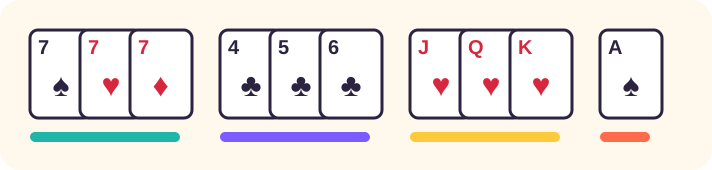
- A set is 3 or 4 cards of the same rank, such as 7♠ 7♥ 7♦.
- A run is 3 or more cards in sequence in the same suit, such as 4♣ 5♣ 6♣ or J♥ Q♥ K♥.
Each card can belong to only one meld at a time. Cards that don't fit into any meld are your deadwood, and their values are added together to give your deadwood count.
Dealing
- Each player cuts the deck; the lower card deals the first hand. After that, the winner of each hand deals the next one (some players have the loser deal instead).
- The dealer gives 10 cards to each player, one at a time.
- The next card, the 21st, is turned face up to start the discard pile.
- The rest of the deck goes face down next to it as the stock.
The first turn
The first turn has a special rule for the face-up card:
- The non-dealer may take the face-up card. If they do, they discard a card and the turn passes to the dealer.
- If the non-dealer doesn't want it, the dealer may take it (and then discard).
- If both players refuse it, the non-dealer starts normally by drawing the top card of the stock.
How a turn works
Every turn has two parts:
- Draw one card: either the top card of the stock (face down) or the top card of the discard pile (face up).
- Discard one card face up onto the discard pile.
You always end your turn with 10 cards. One restriction: if you take the top card of the discard pile, you may not discard that same card on the same turn.
Players keep taking turns until someone knocks, or until the stock runs low (see below).
Knocking
You may knock after drawing, instead of making a normal discard, if your deadwood count would be 10 points or less.
- Discard one card face down.
- Lay out your hand face up, arranged into melds and deadwood.
- Your opponent then lays out their hand in the same way.
Knocking is never compulsory. Sometimes it pays to keep playing for gin.
Going gin
If you knock with no deadwood at all, all 10 cards in melds, that is called going gin. You get a bonus, and your opponent is not allowed to lay off any cards.
Laying off
If you knock with some deadwood (not gin), your opponent may reduce their own deadwood by laying off: adding their unmatched cards to your melds. For example, if you show a run of 5♥ 6♥ 7♥, they can lay off a 4♥ or 8♥ on it, or a fourth card to one of your sets.
Your opponent can only lay off on your melds, never on your deadwood. The knocker can never lay off on the opponent's melds.
Scoring a hand
Compare the deadwood counts after laying off:
| Situation | Who scores | Points |
|---|---|---|
| The knocker has less deadwood | Knocker | The difference in deadwood |
| The knocker went gin | Knocker | 20 bonus + the opponent's full deadwood |
| The opponent has equal or less deadwood (undercut) | Opponent | The difference + 10 bonus |
Example: you knock with 4 points of deadwood. Your opponent has 19, but lays off a card worth 5, leaving 14. You score 14 − 4 = 10 points. If they had got down to 4 or less, they would have undercut you and scored the difference plus 10.
A player who goes gin can never be undercut.
When the stock runs out
The last two cards of the stock are never drawn. If the player who takes the third-last card discards without knocking, the hand ends as a draw: no one scores, and the same dealer deals again.
Winning the game
Keep a running total. The game ends as soon as one player reaches 100 points or more. Then add the bonuses:
| Bonus | Points |
|---|---|
| Game bonus for the winner | 100 |
| Shutout (the loser scored nothing in the whole game) | Game bonus doubled to 200 |
| Line bonus (also called box bonus) | 20 for each hand won, for each player |
The line bonuses don't count towards reaching 100; they are added only at the end. The winner's final score minus the loser's gives the margin of victory.
Scoring variations
Different books and families use slightly different numbers, so agree before you play:
- 25-point bonuses: many older American rulebooks give 25 for gin and 25 for an undercut instead of 20 and 10, with a 25-point line bonus.
- Big gin: if all 11 cards (after drawing) form melds, you may lay out all of them without discarding. This is often worth a 31-point bonus. It is a popular extra, not part of the core rules.
- Oklahoma gin: the value of the first face-up card sets the maximum deadwood you may knock with on that hand (a 10 or picture card means 10, an ace means you must go gin), and a spade as the first card doubles the hand's score.
- Hollywood scoring: players keep three games going at once. A player's first hand win goes on game 1, their second on games 1 and 2, and from the third on all three games.
Strategy tips
- Watch what your opponent picks up. If they take the 8♦ from the discard pile, they're collecting 8s or diamonds around 8. Avoid discarding 7♦, 9♦ and other 8s.
- Get rid of high deadwood early. Unmatched kings and queens cost 10 points each if your opponent knocks. Keep low cards instead; they hurt less and help you knock sooner.
- Knock early when you can. In the first few turns your opponent's deadwood is usually high, so knocking with 8 to 10 points often wins.
- Play for gin late in the hand if your opponent is clearly close to knocking with low deadwood. Gin protects you from an undercut.
- Keep flexible cards. A 6♠ next to 5♠ and 6♥ can become part of a run or a set. Cards that can complete two melds are worth more than they look.
- Count the discard pile. If two 9s are already discarded, a pair of 9s in your hand will never become a set.
Common mistakes
- Discarding the card you just took from the discard pile.
- Knocking with more than 10 points of deadwood.
- Counting the ace as 11 or using it in a Q-K-A run.
- Laying off on the knocker's deadwood, or laying off after the knocker went gin.
- Forgetting the line bonuses at the end of the game.
Gin rummy and its relatives
Gin rummy grew out of older rummy games in the United States in the early 20th century. In other countries you'll find close relatives: Rommé in Germany, rami in France, chinchón in Spain and Latin America, and pife in Brazil. They share the idea of forming sets and runs, but each has its own number of cards, jokers and scoring.
Frequently asked questions
How many cards do you get in gin rummy?
Each player gets 10 cards. The 21st card is turned face up to start the discard pile and the rest form the stock.
When can you knock in gin rummy?
After drawing and before discarding, if the total value of your unmatched cards is 10 or less. Knocking is optional, and you may knock on any turn, including your first.
What is an undercut in gin rummy?
If the player who knocked has a deadwood count equal to or higher than the opponent's after laying off, the opponent undercuts them and scores the difference plus a 10-point bonus.
Can you lay off cards after gin?
No. When a player goes gin, the opponent may not lay off any cards on the gin hand. Laying off is only allowed when the knocker still has some deadwood.
Is the ace high or low in gin rummy?
Low. An ace counts 1 point and can only be used in a run as A-2-3. Q-K-A is not a valid run.
Can you take a card from the discard pile and discard it straight back?
No. If you take the top card of the discard pile, you may not discard that same card on the same turn. You can discard it on a later turn.
What happens if the stock runs out?
When only two cards remain in the stock and the player who drew the third-last card discards without knocking, the hand is a draw: nobody scores and the same dealer deals again.
How many points do you need to win gin rummy?
The usual target is 100 points. The winner then adds a 100-point game bonus and 20 points for every hand they won (line bonus). If the loser scored nothing, the game bonus is doubled to 200.
Sources
We check every rule against these references. Where sources disagree, we say so in the text.