- 👥 Players
- 4
- 🎂 Ages
- 10+
- ⏱ Playing time
- 20–40 min
- ⭐ Difficulty
- Medium
- 🎲 You need
- A 24-card euchre deck (9, 10, J, Q, K, A in four suits), or a standard deck with the 2 through 8 removed, plus a way to keep score (low cards from the deck you removed, or pencil and paper)
- Four players in two partnerships share a 24-card deck; each gets five cards and one more card is turned face up.
- In the first round you can order up the turned card's suit as trump, in the second you name another suit; the side that picks trump must win at least three of the five tricks.
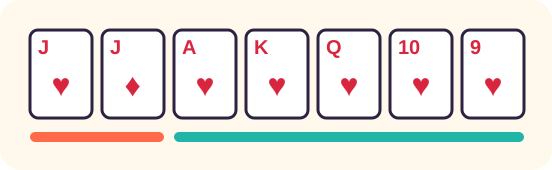
- The jack of trump (right bower) and the other jack of the same colour (left bower) are the two highest trumps.
- Makers score 1 point for three or four tricks and 2 points for all five; if they fail they are euchred and the other side scores 2.
- Going alone doubles the reward for a sweep to 4 points. The first side to 10 points wins.
Euchre is a four-player trick-taking game for two partnerships, played mostly in the American Midwest, Ontario, upstate New York and a few corners of England such as Cornwall. It uses a small 24-card deck, and its best-known quirk is that the jack of the trump suit and the jack of the matching colour are the two highest cards in the game.
This page follows the usual North American rules: four players, a 24-card deck, game to 10. Pagat.com and Bicycle both describe variations on this, and we say where groups play differently. The most common house rules are collected in a separate section further down.
Goal of the game
Your partnership wants to be the first to reach 10 points. Points come from hands: one side chooses the trump suit, and if that side wins at least three of the five tricks it scores. If it falls short, the other side scores instead.
Cards and seating
You need 24 cards: the 9, 10, J, Q, K and A of each suit. Partners sit across from each other, and play goes clockwise. Taking the 2 to 8 out of a normal deck works just as well as a special euchre deck.
Keep score with pencil and paper, or with a couple of the low cards you took out of the deck.
Card order
In a plain (non-trump) suit the cards rank A, K, Q, J, 10, 9. In the trump suit the order changes completely:
| Rank | Card (hearts as trump) |
|---|---|
| 1 | Jack of hearts, the right bower |
| 2 | Jack of diamonds, the left bower |
| 3 | Ace of hearts |
| 4 | King of hearts |
| 5 | Queen of hearts |
| 6 | 10 of hearts |
| 7 | 9 of hearts |
The left bower is always the jack of the same colour as the trump suit. It stops being a diamond and becomes a heart for the whole hand. As a result, when diamonds are led, the jack of diamonds is not a diamond, so you cannot be forced to play it.
With a given trump suit there are exactly seven trumps in the deck: six cards of the suit plus the left bower. The suit of the same colour has five cards left, and the two suits of the other colour have six each.
The deal
The dealer shuffles, the player on the right may cut, and the dealer gives each player five cards, starting with the player on the left. The cards come in two rounds, two then three or three then two. Whoever deals should keep the pattern they start with for that deal.
After the deal, the dealer turns the next card face up on the stack of the remaining cards. That is the upcard. The other three cards stay face down and are not used in this hand. The deal passes clockwise after each hand.
Choosing trump
Trump is decided in two rounds. The side that picks trump are the makers, the other side are the defenders.
First round: the upcard
Starting with the player on the dealer's left and going clockwise, each player either passes or accepts the upcard's suit as trump.
- An opponent of the dealer says "I order it up".
- The dealer's partner says "I assist" or "I order it up" as well.
- The dealer, who is last, accepts by saying "I pick it up".
If someone orders up the suit, the dealer takes the upcard into their hand and discards one card face down. The dealer's side gains a guaranteed trump, so a jack as upcard is especially welcome.
Second round: naming a suit
If all four players pass, the upcard is turned face down. Starting again on the dealer's left, each player may now name any other suit as trump, but not the suit of the turned-down card. Naming the other suit of the same colour is sometimes called "making it next"; naming a suit of the opposite colour is "crossing it".
If all four pass again, the hand is thrown in. The cards are collected and the next player deals.
Going alone
A player with a very strong hand can announce "alone" right after trump is chosen, and before the first card is led. Their partner puts their cards face down and sits out. The big reward comes only from a sweep: three or four tricks still score just 1 point, and fewer than three is a euchre.
Either a maker or a defender can go alone in most groups. Some groups ban lone defenders altogether, others allow them only against a lone maker, and some bar a player who passed in the first round. Ask before you play.
Playing the tricks
The player on the dealer's left leads the first trick. If that player sits out because their partner went alone, the lead goes to the next player clockwise who is still in the hand.
- The leader plays any card face up.
- Everyone else, in clockwise order, must follow suit if they can. Players without that suit may play anything, including trump.
- The trick goes to the highest trump in it, or if there is no trump, to the highest card of the led suit.
- The winner collects the trick and leads the next one.
Five tricks make a hand. Remember that the left bower counts as trump: if you hold the jack of diamonds with hearts as trump, and hearts are led, you must play it when you have no other heart.
Scoring a hand
| Result | Points |
|---|---|
| Makers win 3 or 4 tricks | 1 point to the makers |
| Makers win all 5 tricks (a march) | 2 points to the makers |
| Makers win fewer than 3 tricks (euchred) | 2 points to the defenders |
| A lone maker wins all 5 tricks | 4 points |
| A lone maker wins 3 or 4 tricks | 1 point |
| A lone defender euchres the makers | 4 points |
A lone maker who is euchred gives the defenders the usual 2 points in most groups. The 4 points for a lone defender are not universal, so check with the table before the first deal.
The first side to reach 10 points wins. Some groups play a rubber, the best of three games, but most just play one game. A short game to 5 or 7 points is also common.
A hand from start to finish
You sit on the dealer's left, your partner across the table. The dealer turns up the queen of hearts. Your hand is: J♦, A♥, 10♥, A♠, 9♣.
You order it up: hearts are trump, and you hold the left bower (J♦), the ace of hearts and the 10 of hearts. That is three trumps, a good base. The dealer, an opponent, picks up the queen of hearts and discards a card.
- You lead the J♦ (left bower, a heart). The opponent on your left plays 9♥, your partner plays K♥ and the dealer plays Q♥. The highest trump is the J♦, so you win.
- You lead A♠. The opponent on your left plays 10♠, your partner plays Q♠ and the dealer plays 9♠. You win again.
- You lead the A♥, but the opponent on your left plays the J♥, the right bower, and takes the trick. Your partner and the dealer have no hearts left and throw away small cards.
- The opponent who won the last trick leads a small card, the 9♦. You have no diamonds, so you play the 10♥. Every other trump has been played by now, so it is the highest one left and you win.
- You lead the 9♣ and lose the last trick.
You took tricks 1, 2 and 4, which makes three, so your side scores 1 point. With all five it would have been 2 points. Had you taken only two, you would have been euchred and the opponents would have scored 2.
There are only seven trumps in the deck, so by the third trick you can work out that the 10♥ is the last one left.
House rules and variants
- Stick the dealer. If the first three pass in the second round, the dealer must name a suit, so no hand is ever thrown in. Often used when time is short.
- British euchre. 25 cards with a joker or the 2 of spades as the top trump (the Benny), played to 11 points. In Britain and in some other places, if the dealer's partner orders up the suit, that partner must play alone and the dealer's hand is laid face down.
- 32-card euchre. Adds the 7s and 8s as the lowest cards. Bicycle lists it as a base deck, but 24 cards is the North American norm.
Tips for new players
- Order up with three trumps, ideally including a bower. Two trumps and an off-suit ace is borderline.
- When the dealer is your partner, you can order up a weaker hand, because the dealer gets the upcard. When the dealer is an opponent, be more careful.
- Lead off-suit aces when you are a defender, since they can be trumped later. As a maker, lead trump to pull out the opponents' trumps.
- Count trumps. There are seven in the game, so if you hold three, only four are out there.
- If you have the left bower but not the right, remember the right bower might sit in the dealer's hand.
Common mistakes
- Forgetting that the left bower is a trump and playing it as a card of its printed suit.
- Forgetting to follow trump when trump is led, and in particular holding back the left bower.
- Discarding a card the dealer later needs. Count your hand before you discard.
A short history
Euchre is an old game. The most likely ancestor is the Alsatian game Jucker. Some historians think German settlers brought it to Pennsylvania, and the word "bower" is linked to the German "Bauer". The earliest surviving rules are from 1844. A joker was added to euchre packs in the 1850s. It was once considered a national card game of the United States, and a world championship is held every year in New Glarus, Wisconsin. See also Spades, another partnership trick-taking game.
Frequently asked questions
How many cards do you need to play euchre?
A standard euchre deck has 24 cards: the 9, 10, jack, queen, king and ace of each suit. If you only have a normal 52-card deck, take out everything from the 2 to the 8.
What is the difference between the right bower and the left bower?
The right bower is the jack of the trump suit and beats everything. The left bower is the other jack of the same colour and is the second-highest trump. If hearts are trump, the jack of hearts is the right bower and the jack of diamonds is the left.
How many points do you need to win euchre?
In North America a game is played to 10 points. British games usually go to 11, and some groups play a short game to 5 or 7. Agree on the target before the first deal.
What does it mean to be euchred?
If the side that chose trump wins fewer than three of the five tricks, they have been euchred. The opponents score 2 points instead of the makers scoring anything.
How does going alone work in euchre?
A player can announce "alone" after trump is set and before the first lead. Their partner puts their cards face down and sits out. A lone player who takes all five tricks scores 4 points, and three or four tricks still score just 1.
What is stick the dealer?
It is a popular house rule for the second round of naming trump. If the three players before the dealer pass, the dealer has to name a suit, so a hand is never thrown in.
Do you have to follow suit in euchre?
Yes. If you can follow the suit that was led, you must. If you cannot, you may play any card, including a trump. Remember that the left bower counts as a trump, not as a card of its printed suit.
Can you play euchre with two or three players?
The standard game is for exactly four players in partnerships. Variants for other numbers exist, but they are separate games with their own rules, so this page covers the four-player game only.
Sources
We check every rule against these references. Where sources disagree, we say so in the text.