- 👥 Players
- 2–4
- 🎂 Ages
- 6+
- ⏱ Playing time
- 15–45 min
- ⭐ Difficulty
- Easy
- 🎲 You need
- A double-six domino set (28 tiles), a flat table, paper and pen for scoring
- Mix the 28 tiles face down. In a two-player game each player takes 7; the rest stay face down as the boneyard.
- Start the line with one tile, then take turns adding a tile whose end matches a number at either end of the line.
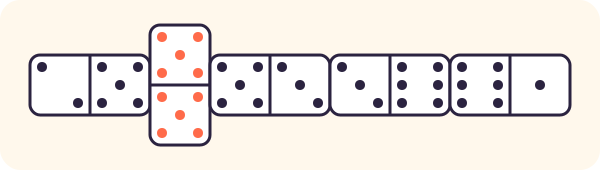
- Doubles go across the line. In the standard games they are not spinners, so the line stays a single row.
- In draw dominoes you pick from the boneyard when you cannot play. In block dominoes you pass.
- Go out first, or hold the fewest pips when the game blocks, and you score the pips the others hold, minus your own.
Dominoes needs nothing but 28 tiles and a table, and a game takes ten minutes to learn. The oldest recorded mention of Chinese dominoes comes from the Song dynasty, while the European game first appears in France in the mid-1700s. This page explains the double-six game as it is played in English-speaking countries: the basic block game first, then draw dominoes, then All Fives, the version many people play when they want points along the way.
The numbers below follow the rules published on Pagat, the card and tile game reference by John McLeod. Where groups disagree, the common version comes first and the others follow.
The goal
In every version you try to play all your tiles before anyone else does. When a hand ends, the player (or side) with the fewest pips left scores the difference between the others' pips and their own. You play several hands until someone reaches the target score.
The tiles
A double-six set has 28 tiles. Each tile is split into two halves, and each half shows a number from blank (0) to 6. There is exactly one tile for every pair of numbers:
| Kind | How many | Examples |
|---|---|---|
| Doubles | 7 | 0-0, 3-3, 6-6 |
| Singles | 21 | 1-4, 2-6, 0-5 |
| Total | 28 |
A tile that shows the same number twice is a double. The face-down pool you draw from is the boneyard (also called the stock). Every number from 0 to 6 appears on seven tiles (six singles and one double), so you can always work out how many tiles of a number are still hidden.
All 28 tiles add up to 168 pips. That is handy to remember: if your hand and the table add up to less than that, an opponent or the boneyard holds the difference.
Setup and deal
Turn all tiles face down and shuffle them by pushing them around the table. Each player draws their hand and stands the tiles on edge so the others cannot see them. The deal depends on the game:
| Game | 2 players | 3 players | 4 players |
|---|---|---|---|
| Block | 7 | 5 | 5 |
| Draw | 7 | 7 | 6 |
| All Fives | 7 | 5 | 5 |
The tiles left over make the boneyard. In block dominoes they simply stay unused.
Players draw for the first lead, for example by each picking a tile and letting the highest take it. In block and draw dominoes the lead then passes to the left of the previous leader. In All Fives the player who went out leads the next hand, and after a blocked hand the lead is drawn again. Many groups start with the highest double instead.
How a turn works
The first player puts down any tile. Everyone after that adds one tile to either end of the line, so that the touching halves show the same number. If one end shows a 4, you can play any tile with a 4 on it, turning it so the 4 meets the 4.
Doubles are laid across the line, at right angles. In the standard games a double does not branch the line (that would be a spinner), so you only ever have two open ends.
If you cannot play, what happens depends on the version:
- Block: you pass.
- Draw: you must take tiles from the boneyard until you can play. You never draw the last two tiles. When only two are left and you cannot play, you pass.
- All Fives: you draw until you find a tile that fits, and the drawn tile is played at once. If the boneyard is empty, you pass.
In draw dominoes you may even draw when you could play. Players sometimes do it on purpose to hide a number or to hunt for a tile that blocks the line.
Ending a hand
A hand ends in one of two ways:
- Domino. A player plays their last tile ("goes out") and says "domino".
- Blocked game. Nobody can play any more. This happens when both ends show numbers that are completely used up, for example both ends are 5 and all seven 5-tiles are on the table. In draw dominoes the hand also ends when the boneyard is down to two tiles and nobody can play.
Scoring in block and draw dominoes
When the hand ends, every player adds the pips in their remaining tiles. The player with the lowest total wins the hand and scores the sum of the others' totals minus their own total. If the lowest total is tied, nobody scores.
The standard targets are 100 points for two players or partnerships and 61 points for three or four players. Pagat points out that 61 fits a cribbage board, which is how many people keep score.
British clubs play an optional extra: if the winner went out with a tile that could have been played on either end, or went out with a double, the opponents' points are doubled. You do not need these at home.
All Fives (Muggins)
All Fives is the scoring game. You still try to go out, but you earn points along the way.
After each tile is played, add the numbers on the two ends of the line. If the sum is a multiple of 5 (5, 10, 15, 20 and so on), you score that sum immediately. A double lying across an end counts both its halves, so a 5-5 at an end is worth 10 on its own.
At the end of the hand, each player counts the pips left in their hand and rounds the total to the nearest 5: 1-2 (3 pips) rounds to 5, 1-1 (2 pips) rounds to 0. The usual way to score this is that the player who went out collects the rounded totals of the others. Pagat's scoring section words it as subtracting each holder's rounded total from that player's own score, so agree on one method before you start.
The usual target is 200 points for three or four players and 250 for two. Four players can also play in partnerships to 250. Some tables add one point for going out.
A worked example (All Fives, two players)
Anna and Ben each hold 7 tiles. Anna leads.
- Anna plays 6-4. The ends are 6 and 4, sum 10. She scores 10.
- Ben plays 4-1 on the 4. The ends are 6 and 1, sum 7. No score.
- Anna plays 6-3 on the 6. The ends are 3 and 1, sum 4. No score.
- Ben plays 1-2 on the 1. The ends are 3 and 2, sum 5. Ben scores 5.
After four tiles the score is Anna 10, Ben 5. Ben needed no big tile: he only read the two ends and found a fit that made 5.
Variations and house rules
- Draw limits. Some tables allow only one or two draws before you must pass.
- Opening double. Puerto Rican rules for two or three players make the holder of 6-6 (or the highest double dealt) lead it, and let you draw only when you cannot play. The winner scores all the pips left in the other hands.
- Dutch rule. The 0-0 counts as 13 points in one Dutch variant of draw dominoes.
- Partnerships. Four players can sit in pairs, partners opposite each other, and add their scores.
- Other games. Wikipedia lists Matador, Mexican Train and Texas 42 as separate games played with the same tiles.
Tips for better play
- Get rid of doubles early. A double can be played only at an end showing its own number, so a late double is a trap.
- Count the numbers. There are seven tiles of each number. When you have four 3s and three are on the table, nobody else can match a 3 and you have control.
- Keep your options open. Hold tiles with different numbers so that whatever shows at the ends, you can play.
- Block when you hold few pips. Aim for a line that nobody can continue.
- Watch the passes. In block dominoes and All Fives, an opponent who passes has no tile with either end number. Use that.
Common mistakes
- Laying a double lengthwise. It goes across the line.
- Adding the sum of the whole line in All Fives. Only the two open ends count.
- Forgetting that in draw dominoes the last two tiles stay in the boneyard.
- Scoring a tied lowest hand in block dominoes. A tie means no score.
- Mixing up rounding: round the leftover pips to the nearest 5, not always up.
A short history
Dominoes in their European form first appear in France in the mid-18th century, and the name is first recorded in 1762. Chinese dominoes are much older, but there is no confirmed link between the two.
Frequently asked questions
How many dominoes does each player get?
In a two-player game each player takes 7 tiles. With three or four players it is 5 each in block dominoes and All Fives, while draw dominoes uses 7 each for three players and 6 each for four. The tiles nobody takes form the boneyard.
Who goes first in dominoes?
Standard rules let the players draw for the first lead. In block and draw dominoes the lead then passes to the left each hand, while in All Fives the player who went out leads. Many groups simply let the holder of the highest double start, so agree on one method first.
What happens when you cannot play a domino?
In draw dominoes you take tiles from the boneyard until you can play, but you never take the last two. In block dominoes there is no drawing and you pass. In All Fives you draw until you find a playable tile, and you pass only when the boneyard is empty.
What is a blocked game in dominoes?
A blocked game is one where nobody can play, usually because both ends of the line show a number whose seven tiles are all on the table. Everyone then counts the pips left in their hand, and the lowest total wins the hand.
How do you score in All Fives?
After every tile you add the numbers at the two ends of the line. If the sum is a multiple of 5, you score that sum at once. A double at an end counts both halves, so a 5-5 at the end is worth 10.
How many dominoes are in a set?
A standard double-six set has 28 tiles, one for every pair of numbers from blank to six. All 28 tiles together carry 168 pips. Bigger sets such as double-nine (55 tiles) and double-twelve (91 tiles) exist for larger groups.
What is a spinner in dominoes?
A spinner is a double that can be played on all four sides, so the line branches. The standard block, draw and All Fives rules described here do not use spinners.
How many points do you play to in dominoes?
For block and draw dominoes the usual target is 100 points for two players or partnerships, and 61 points for three or four players. All Fives is played to 200 points for three or four players and 250 for two players or four-player partnerships.
Sources
We check every rule against these references. Where sources disagree, we say so in the text.