- 👥 Players
- 2–7
- 🎂 Ages
- 6+
- ⏱ Playing time
- 10–30 min
- ⭐ Difficulty
- Easy
- 🎲 You need
- One standard 52-card deck (two decks for more than five players), and paper and pen if you keep score
- Deal 5 cards each (7 each with two players), put the rest face down as the stock and turn one card up to start the discard pile.
- On your turn, play a card that matches the top card by suit or by rank.
- An eight is wild: play it on anything and name the suit the next player must follow.
- If you cannot play, draw from the stock. Under the basic rules you may also draw when you can play.
- The first player to get rid of every card wins the round and scores the value of the cards left in the other hands.
Crazy Eights is a shedding game for two or more players with an ordinary deck. Each player tries to empty their hand first by matching the top card of the discard pile by suit or rank, and the eights are wild.
The rules below follow the card-game reference Pagat, the Bicycle rulebook and Wikipedia. Where groups really do disagree, such as what happens when you cannot play, the page says so and tells you the common options.
Goal of the game
Be the first to get rid of all your cards. When someone does, the round ends and that player scores points for the cards still in the other hands. Over several rounds, the first player to reach an agreed target wins the match. If you only play a single round for fun, the person who goes out first simply wins.
Cards and players
Crazy Eights uses a standard 52-card deck with no jokers. Up to five players share one deck. With more players, shuffle two decks together.
Suits do not rank. Ranks matter only for matching, and for scoring at the end of a round.
Setup and deal
- Pick a dealer by any method you like.
- Shuffle and deal 5 cards to each player, one at a time. With only two players deal 7 each.
- Put the rest of the deck face down in the middle as the stock.
- Turn the top card of the stock face up beside it. That is the start of the discard pile.
- If the starter is an eight, the Bicycle rulebook slips it into the middle of the stock and turns another. Pagat treats it as if the dealer had just played it and lets the dealer name the suit. Pick one rule.
The player to the dealer's left goes first, and play moves clockwise.
How a turn works
On your turn you play one card from your hand on the discard pile, or draw if you cannot or choose not to play. The card has to match the top card in one of two ways:
- the same suit (any club on a club), or
- the same rank (any queen on a queen).
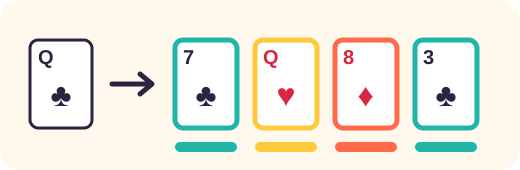
The picture above shows it: with the queen of clubs showing, you can play the seven of clubs, the three of clubs, the queen of hearts, or an eight. A seven of hearts is no good.
If you cannot play, you draw from the stock. In the basic game, you keep drawing until you pick up a card you can play, and then you play it. Some groups say you draw one card and, if it does not fit, your turn ends. What matters is that everybody at the table plays the same one.
In the basic rules you are also allowed to draw while holding a playable card, for instance to keep an eight for later.
The eights
An eight can be played on any card, at any time on your turn, with no need to match suit or rank. When you play it, you name a suit, and the next player must follow that suit or play another eight. The rank of the eight itself no longer matters, so naming the suit is the whole effect.
This shapes your tactics:
- Name the suit you hold the most of. Fewer cards that cannot be played means fewer draws.
- Do not waste eights early. They are worth 50 penalty points if you are stuck with them, so they are an escape hatch and a liability at the same time.
- If the eight you played was your second-to-last card, pick the suit of your last card.
When an eight is on top of the pile, the next player has no rank to match, only the named suit. A second eight is allowed on it, and the new player gets to name the suit.
Special cards in house rules
The traditional rules have only the eights. Plenty of tables add effects to other cards, which turns Crazy Eights into something closer to UNO. These are the common ones:
| Card | Common effect |
|---|---|
| Queen | The next player misses a turn. With two players, you play again. |
| Ace | Direction of play reverses. With two players it has no effect. |
| Two | The next player draws two cards, or plays another two. Twos can stack, so two twos make the next player draw four. |
Pagat also lists tables where a jack, an ace or a seven changes the suit. If the last card a player goes out with is one of these special cards, its effect is ignored.
When the stock runs out
Sooner or later the stock is empty. In the standard game, you leave the top card of the discard pile where it is, shuffle the rest and turn it over as a new stock.
Pagat describes a rarer variant in which nobody reshuffles. Play continues without drawing, and a player who cannot play simply passes. If everybody passes in a row, the round is blocked and ends. Wikipedia then has the player with the lowest hand score the difference between their hand and each opponent's hand, while Pagat has every player score the cards left in their own hand. Pick one before the deal.
Scoring
When a player goes out, every other player counts the cards left in their hand:
| Card | Penalty points |
|---|---|
| Eight | 50 |
| King, queen, jack, ten | 10 each |
| Ace | 1 |
| Two to nine (except eights) | face value |
The winner of the round collects the total from all opponents.
Example. Anna goes out. Ben still holds an 8♦, a K♠ and a 5♥: that is 50 + 10 + 5 = 65. Carla holds a J♣, an A♠, a 9♦ and a 2♥: 10 + 1 + 9 + 2 = 22. Anna scores 65 + 22 = 87 points for the round.
A common target is 50 points per player, which means 100 for a game of two, 150 for three, 200 for four and so on. Because one stranded eight is worth 50, a single bad round can swing the whole match.
A short round
Take three players with 5 cards each, and a 6♠ turned up. Dana, left of the dealer, starts.
- Dana holds 6♥, so she plays it by rank. The top card is now 6♥.
- Eli has no heart and no six. He draws a K♣, then a 4♥. The 4♥ matches the suit, so he plays it.
- Fay has an 8♣. She plays it on the 4♥ and calls "diamonds", because she has three diamonds in hand.
- Dana has no diamond and no eight, so she draws until she gets a 9♦ and plays it.
- The round goes on like that until someone has one card left. Many groups require the player to say "last card" before the next turn, with a two-card penalty for forgetting. Some tables skip this rule.
Variants and house rules
- Draw until you can play (the basic game) versus draw one card only. The second is faster, the first is more forgiving.
- Eights restricted. In some versions you can play an eight only when it matches the suit or rank, so it is not truly wild.
- Draw two. Twos force the next player to take two cards unless they answer with another two.
- Crazy Eights Countdown. Everyone starts with a score of 8 and eight cards. Going out lowers your score by one and you are dealt a new hand of that many cards. Your wild rank is always your current score: eights first, then sevens, and so on. The first player to reach zero wins.
- Playing several cards of one rank in one turn, so a pair of queens skips two players.
- Naming no suit. In a mild version the eight does not name a suit, and the next player just matches its suit.
Always settle the variant before the first card is played. Two players who each remember a different version are the usual source of arguments.
Tips for better play
- Count suits in your hand when you choose what to name after an eight. If you hold four spades, name spades.
- Get rid of high cards first when you have a choice. Kings, queens and jacks cost 10 points each at the end, and low cards cost little.
- Keep an eight for the end, but not too long. An eight in your hand when somebody else goes out costs 50.
- Watch what others draw. If a player had to draw when a suit was on top, they probably hold few cards of it, so naming that suit makes them draw again.
Common mistakes
- Playing an eight and forgetting to name a suit. The next player then has nothing to match. Say it out loud.
- Playing a card that matches neither suit nor rank because "it looks close". The rule is exact.
- Mixing rules from UNO: there is no draw-four card and no colour wild.
- Not agreeing on the empty stock before it happens.
Where the game comes from
Crazy Eights belongs to the "eights" family of shedding games. Wikipedia dates the name Eights to the 1930s and Crazy Eights to the 1940s. Nobody knows for sure where the name comes from. One theory ties it to the "Section 8" discharge from the United States army, and another links the game to the German Mau-Mau. Pagat lists the same family under other names: Switch, Pesten in the Netherlands and Tschau Sepp in Switzerland.
The best-known commercial relative is UNO, built on the same pattern with its own deck.
Frequently asked questions
How many cards do you deal in Crazy Eights?
Five cards each is the standard deal for three or more players, and seven each when two people play. The rest of the deck becomes the stock, and the top card is turned face up to start the discard pile.
What happens when you play an eight in Crazy Eights?
An eight can be played on any card, whatever its suit or rank. You name a suit, and the next player must play a card of that suit or another eight.
What if you can't play a card?
You draw from the stock. In the version on this page you keep drawing until you can play, but some groups limit it to one card or let you pass after one draw. Agree on this before the first deal.
Can you draw a card even if you have a playable one?
Under the basic rules, yes. It is a classic way to hold on to an eight for later, at the price of a bigger hand. Many house rules forbid it, so check with your table.
What happens if the stock runs out?
In the standard game the discard pile, except the top card, is shuffled into a new stock. A rarer variant, described by Pagat, has play continue without drawing, and players who cannot play pass. If everyone passes, the round is blocked and ends.
How do you score Crazy Eights?
The winner of the round collects points for the cards left in each opponent's hand: 50 for an eight, 10 for a king, queen, jack or ten, 1 for an ace, and face value for the other cards. A common target is 50 points per player, so 100 in a two-player game.
Is Crazy Eights the same as UNO?
UNO is a commercial game from the same family, with its own deck and special cards. Crazy Eights uses an ordinary deck, and the eight is its only fixed special card.
Can you win the game by playing an eight as your last card?
Yes. An eight can be your last card. If your last card has a house-rule effect, that effect is ignored.
Sources
We check every rule against these references. Where sources disagree, we say so in the text.